

I recently listened to an excellent episode of The AI Daily Brief in which host Nathaniel Whittemore explores how AI agents are transforming video production. His central observation is that we’re reaching an inflection point where virtually anyone can create sophisticated video without specialized production skills.
The episode, “Agentic Video Is Real and Here’s What You Should Try,”, is worth a listen, particularly for anyone responsible for communicating, educating, or leading people inside an organization.
Whittemore focuses on video, but I’d extend his thesis to include audio. Both are streaming media, and both are becoming dramatically easier to produce with AI.
For the past five years, we’ve been working alongside Fortune 500 companies to help them embrace a future where streaming audio and video become everyday tools for leadership, learning, and workforce engagement. We’ve seen firsthand how powerful these formats can be, but also how the cost and complexity of production have constrained their use.
AI is changing that equation. It’s a powerful tailwind for a transformation that’s already underway.
Here are three takeaways that stood out to me from the episode:
1. Media is often a better way to communicate. We just haven’t been able to use it enough.
One of the most interesting parts of Whittemore’s discussion is his examination of when video is a better communications tool than a document, presentation, or meeting.
He identifies six conditions, including situations where showing is better than telling, where the audience is unlikely to read a document, where explanations must be repeated, where multiple languages are needed, where recordings already exist, and where conviction or emotion matters.
His practical question is a good one:
“who needs this thing that I’m making but won’t actually read the doc?”
I’d broaden that question: When would someone be better served by watching or listening rather than reading?
Consider the possibilities:
- Leadership communications: Hearing an executive explain a strategy conveys conviction, emotion, and intent that can be difficult to capture in a memo.
- Training and enablement: Demonstrations, narrated walkthroughs, and podcasts can make complex information easier to understand and revisit.
- Meeting highlights: A two-minute excerpt of a meaningful debate can be more revealing than pages of meeting notes.
- Customer insights: Hearing customers describe their experiences brings their perspectives to life for people making product and business decisions.
- Frontline communications: Short, mobile-friendly audio and video updates allow employees to stay informed without being tied to a desk.
Video is especially powerful when information benefits from being seen. Audio has its own superpower: it allows people to engage while commuting, walking, or doing other things.
And both formats have something in common that written communications often struggle to replicate: the human voice, with all its nuance, emotion, and ability to create connection.
This isn’t theoretical. We’ve watched global enterprises build thriving internal streaming networks that give leaders a direct voice in employees’ ears, make expertise accessible on demand, and turn communications into an ongoing relationship rather than a series of disconnected announcements.
The opportunity has always been bigger than replacing documents with videos or podcasts. It’s about using the right medium to make communication more accessible, engaging, and effective.
2. AI is finally removing the barriers to media creation.
Until recently, one of the biggest obstacles to using more audio and video at work was production.
Creating even a relatively simple piece of media could require scripting, recording, editing, graphics, narration, and postproduction expertise.
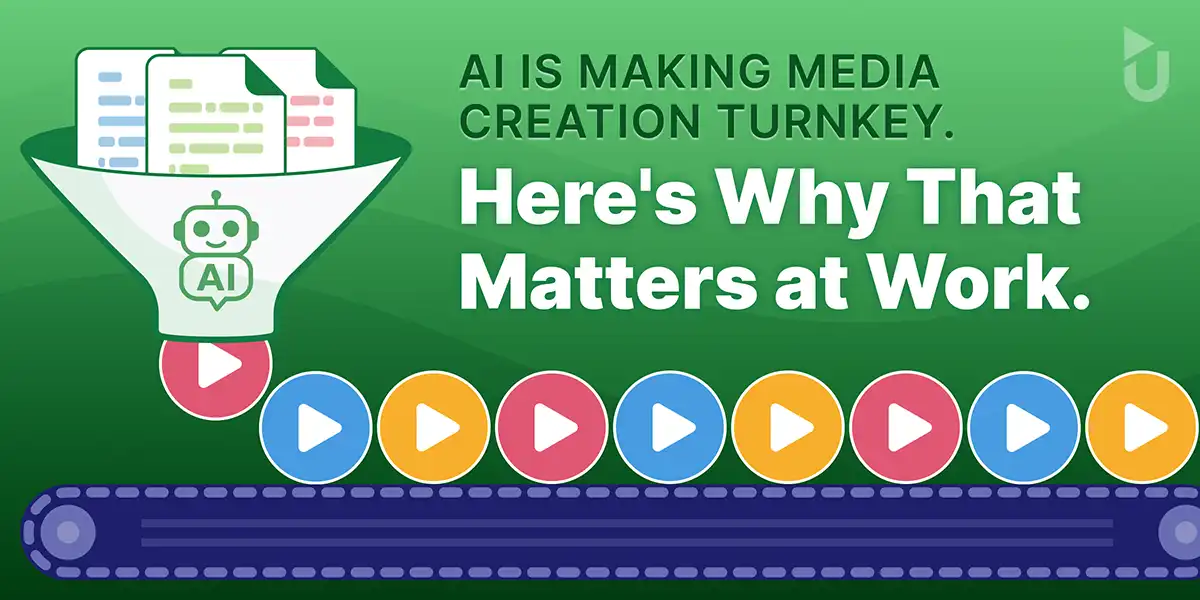
Whittemore describes how AI is radically simplifying that process. Agents can review hours of recordings, identify important moments, assemble highlights, generate animations, and produce polished content through natural-language instructions.
The implications are significant.
Imagine turning a strategy document into a five-minute podcast, converting a product demonstration into a collection of short training clips, or transforming a lengthy executive presentation into a concise, engaging video update.
These are exactly the opportunities we’re pursuing through uStudio Labs, where our focus is making media creation turnkey for enterprise users.
With Autocast, we’re already making it possible to turn written content into professionally produced audio, using AI to create scripts, narration, and music, with human review built into the process.
And with Shorts, we’re working to make it easy to transform long-form media into short, shareable clips that extend the reach and value of existing content.
Our goal is simple: make producing useful, engaging media as easy as creating a document or sending an email.
What’s exciting is that AI doesn’t require enterprises to rethink why they should use media. Many have already discovered its value. AI simply makes it possible to use media far more frequently, for far more purposes, without the traditional production overhead.
And this isn’t about replacing professional producers. It’s about making media practical for the thousands of everyday business communications that have never justified a production budget.
3. The next frontier: media that creates and updates itself.
Perhaps the most exciting idea Whittemore explores is the emergence of agentic media pipelines.
Today, most audio and video are static. We create something, publish it, and eventually it becomes outdated.
But what if media could continuously refresh itself as the underlying information changes?
Imagine an onboarding podcast that automatically incorporates new company policies. A product training video that updates when the software changes. Or a weekly business briefing that assembles the latest metrics, highlights, and commentary into a short narrated presentation.
Instead of producing each piece of media from scratch, an AI agent could monitor approved information sources, identify changes, update scripts, generate new audio or video, and prepare the content for publication.
That is a fundamentally different model.
Content becomes less of a finished artifact and more of a living, evolving communications resource.
Of course, enterprises will need to ensure accuracy, maintain appropriate approval workflows, and govern what gets published. But these are solvable challenges, and the opportunity is extraordinary.
We’re exploring this future through uStudio Labs, building on our existing work to automate media creation and support the entire media lifecycle.
In many ways, this is the natural evolution of the always-on streaming networks we’ve been helping enterprises build for years. AI makes it possible for the content itself to become as continuous and dynamic as the communications channels that deliver it.
The Bigger Picture: The Infrastructure Is Ready. AI Is the Tailwind.
For years, we’ve believed that audio and video would become essential infrastructure for how enterprises communicate, educate, and align their people.
We’ve invested in that future, building the secure distribution, consumer-grade experiences, enterprise integrations, and analytics that allow Fortune 500 organizations to operate their own private streaming networks.
And we’ve learned something important along the way: creating content isn’t the same as communicating effectively.
Enterprises still need to get the right information to the right people, make it easy to discover and consume, and understand whether it’s actually making a difference.
That’s why we believe in measuring more than views and downloads. The real questions are whether employees are engaging, learning, changing how they think, and ultimately performing differently.
AI is now removing one of the last major barriers to making media an everyday part of work: the effort required to create it.
For organizations that have already embraced streaming media, this opens up extraordinary new possibilities. For those just getting started, the path has never been easier.
The future isn’t simply more audio and video. It’s a workplace where important information can be communicated more naturally, continuously, and effectively.
It’s the future we’ve been building toward. And AI is helping bring it to life.
Listen to the full episode of The AI Daily Brief: Agentic Video Is Real and Here’s What You Should Try.