
Nice to Have to Must Have: Reframing Enterprise Podcasting for 2026
Molly Beck | Blog, Industry Trends, Podcasting
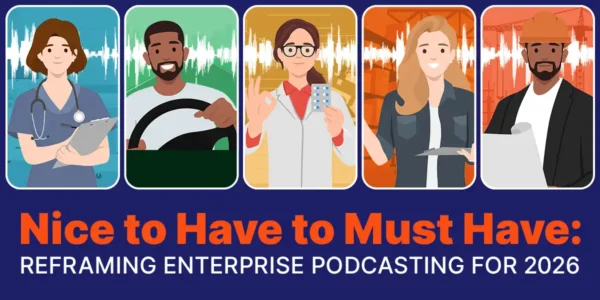
Why Enterprise Podcasting Is No Longer a “Nice to Have”
Enterprise podcasting keeps showing up in conversations for a reason.
It surfaces during employee engagement surveys.
It appears in enablement retrospectives.
It comes up when leaders review what actually gets consumed versus what gets sent.
What used to feel like an experiment now feels like a gap.
Organizations are realizing that internal communication strategies built around email, meetings, and static platforms are struggling to keep up with how work actually happens. Podcasting enters the picture not as a trend, but as a response to friction that already exists.
This is why enterprise podcasting is moving from “interesting idea” to “expected capability.”
Work Has Changed. Most Internal Communication Hasn’t.
Work is no longer anchored to desks or predictable schedules.
Employees move between locations, devices, and contexts throughout the day. Deskless workers rarely sit in front of a screen. Hybrid teams split attention across meetings, inboxes, and tools. Even fully remote employees experience screen fatigue long before the day ends.
Internal communication strategies, however, still assume focused, screen-first consumption.
Audio fits where those assumptions break down.
Podcasting allows communication to travel with employees instead of competing for their attention. It fits into commutes, walks, repetitive tasks, and moments when screens are unavailable or unwelcome. Formats that align with real behavior get used, while those that don’t quietly fade.
This is not about multitasking. It is about alignment.
Why Email And LMS Can’t Carry The Load Alone
Email and LMS platforms still matter. They just cannot do everything.
Email is optimized for notification, not sustained engagement. Messages arrive in crowded inboxes and compete with urgent, transactional work. Even important updates are skimmed, postponed, or lost entirely. This is especially true in internal communication strategies built around email, meetings, and static platforms, where distribution exists but consumption does not.
LMS platforms excel at compliance and structured learning. They are built for scheduled participation and completion tracking. They are far less effective for ongoing communication, leadership messaging, or timely updates.
Podcasting fills the space between these tools.
It offers a way to deliver information that does not require immediate action or a screen. It allows employees to consume content on their terms, without logging into another system or sitting through another meeting.
This is why podcasting is not replacing email or LMS platforms. It is complementing them where they fall short.
Podcasting As Baseline Communication Infrastructure
The shift happening now is subtle but important.
Enterprise podcasting is no longer being evaluated solely on content quality or engagement spikes. It is being evaluated on reliability, accessibility, and fit within broader communication ecosystems.
When podcasting is treated as baseline communication infrastructure, it becomes:
- Always available
- Mobile-first by default
- Low friction to access
- Consistent across teams and roles
This is also where many teams begin asking how to move from recognition to justification and building a business case for internal media platforms.
At that point, podcasting stops feeling like a channel and starts feeling like part of the environment.
By 2026, employees will expect important internal messages to be available in formats that fit their day. Audio will be one of those expectations.
One Format, Many Enterprise Moments
One reason enterprise podcasting is gaining traction is its versatility.
Leadership teams use audio to communicate strategy and vision without relying on live attendance. Enablement teams use it to reinforce messaging without pulling people out of their workflow. HR and people teams use it to support onboarding, culture, and connection.
Change management efforts benefit from audio because it allows leaders to speak directly and consistently during periods of uncertainty. Training teams use it to supplement formal programs with context and reinforcement.
Employee expectations are increasingly shaped by modern media experiences, whether leaders acknowledge it or not. Once audio is available, these use cases emerge naturally. They do not require reinvention. They require access.
What Leaders Will Be Expected To Have Figured Out By 2026
The question leaders are beginning to face is not whether enterprise podcasting works.
It is whether their organization is prepared for expectations that are already forming.
By 2026, enterprise podcasting will be judged less as an innovation and more as a baseline capability. Organizations that delay will not be seen as cautious. They will be seen as out of step with how employees expect to receive information.
The most effective internal communication strategies will be those that adapt to behavior rather than fight it. Audio does not solve every problem, but it solves a critical one: reaching people where they already are.
Enterprise podcasting is moving from nice to have to must have not because it is new, but because it fits.
FAQs:
What is enterprise podcasting?
Enterprise podcasting is the use of secure, internal audio channels to deliver leadership communication, training, and updates to employees.
How is internal podcasting different from public podcasts?
Internal podcasts are private, access-controlled, and designed for employee communication rather than external audiences.
Who benefits most from enterprise podcasting?
Distributed teams, deskless workers, sales organizations, and leadership teams benefit most from audio-first communication.
Is enterprise podcasting secure?
Yes, when delivered through platforms designed with enterprise-grade security, access controls, and governance.

Molly Beck is Head of Marketing at uStudio. She has spent her career helping organizations build and scale podcast programs — from launching the Forbes Podcast Network to developing enterprise podcast software at WorkPerfectly, later acquired by uStudio. She combines creative and technical expertise, having hosted her own Apple New & Noteworthy podcast while also guiding leaders at global companies on how to unlock enterprise streaming as a strategic internal communication channel.