




The TLDR;
- Executives do not reject podcasts. They reject unclear business value
- Leading with gear, studios, or formats signals immaturity
- Strong pitches anchor podcasts to outcomes leaders already care about
- Champions earn credibility by framing podcasts as infrastructure not content
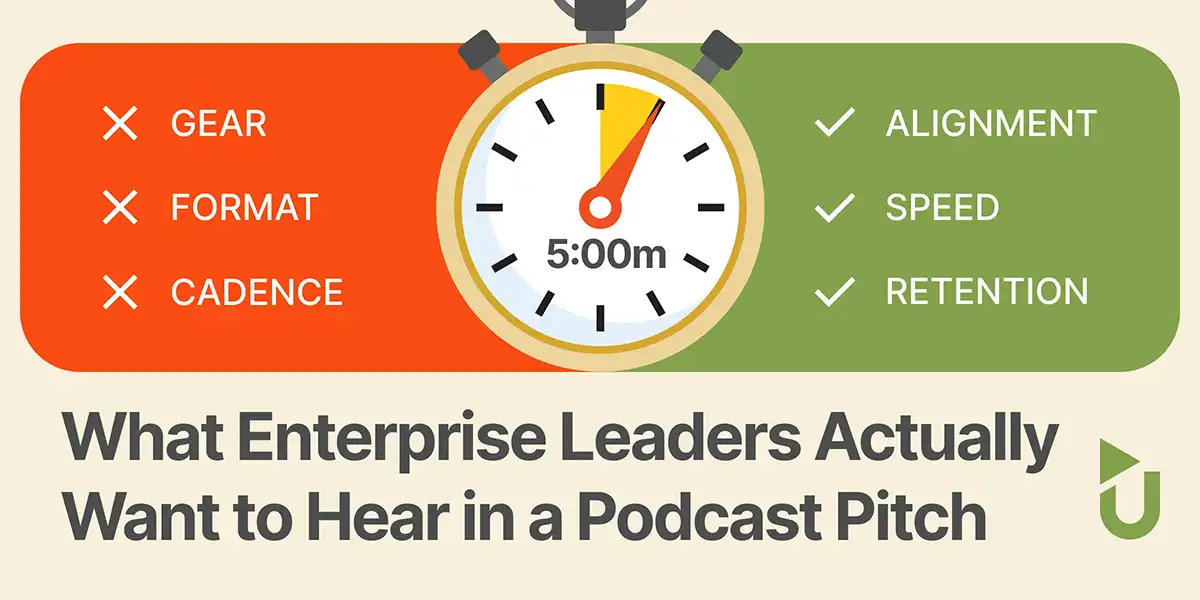
Most enterprise podcast pitches die in the first five minutes.
Not because leaders hate podcasts.
Not because they do not believe in audio.
Not because they are stuck in the past.
They die because the pitch starts in the wrong place.
Mics.
Formats.
Recording equipment.
Thumbnail design.
Frequency.
Hosting platforms.
To an executive, that sounds like noise. It signals that the person pitching is thinking tactically instead of strategically. And once that signal is sent, it is very hard to recover.
Enterprise leaders are not asking “how do we make a podcast.”
They are asking “why does this matter to the business.”
If your pitch does not answer that question quickly and clearly, you lose momentum. And often credibility along with it.
What Executives Are Actually Evaluating
When an enterprise leader hears a podcast pitch, they are not evaluating creativity.
They are evaluating risk.
Specifically:
- Strategic alignment
- Operational impact
- Ownership and control
- Longevity
They want to know:
- Does this support an existing priority
- Does this scale across teams or regions
- Does this create another tool sprawl problem
- Does this die quietly in six months
Executives are trained to spot initiatives that feel exciting but collapse under real world complexity. A podcast framed as a content project feels fragile. A podcast framed as a communication system feels durable.
That distinction matters more than most champions realize.
Why Leading With Tools Kills Momentum
Starting with tools tells the wrong story.
When a pitch begins with:
- “We need a studio”
- “We want to buy microphones”
- “We want to use this platform”
The subtext executives hear is:
- This is a side project
- This requires new budget categories
- This will need ongoing justification
- This will be hard to govern
Even if none of that is true, perception sets the tone.
Executives expect tools to follow strategy, not lead it. When tools come first, leaders assume the thinking has not gone deep enough yet. And many will stop the conversation there.
That is why so many podcast ideas stall at “sounds interesting but not right now.”
The Outcomes Executives Actually Care About
Strong enterprise podcast pitches anchor to outcomes leaders already measure.
These typically fall into a few buckets.
Alignment And Consistency
Leaders want fewer messages landing better, not more messages landing worse. Podcasts can replace fragmented updates, inconsistent town halls, and unread emails with a consistent narrative voice.
Speed Of Communication
Executives care deeply about how fast strategy moves from leadership to execution. Audio reduces friction. It shortens the distance between intent and understanding.
Trust And Transparency
Audio carries tone in a way documents never will. Leaders who want to build trust across distributed or deskless teams see this immediately when framed correctly.
Knowledge Retention
Executives worry about information decay. Podcasts create durable, replayable knowledge that survives org changes and growth.
Notice what is missing from this list.
No mention of format.
No mention of gear.
No mention of publish cadence.
Outcomes first. Mechanics later.
How To Frame A Podcast As Infrastructure
The most effective enterprise pitches position podcasts as infrastructure, not content.
That means shifting language.
Instead of: A podcast series
Say: A leadership communication channel
Instead of: Episodes
Say: Executable updates
Instead of: Content calendar
Say: Delivery framework
You get the idea.
This reframing changes how leaders categorize the investment. Infrastructure lives longer. Infrastructure gets protected. Infrastructure scales.
Content gets questioned.
A Practical Structure That Builds Credibility
For internal champions, structure matters more than polish.
Here is a structure that consistently earns executive buy in.
Start With The Problem
Name a problem leaders already feel. Message overload. Inconsistent communication. Strategy dilution at scale.
If they nod here, you are on track.
Connect To A Priority
Tie the problem directly to an existing initiative. Transformation. Growth. Safety. Culture. Enablement.
Do not introduce a new priority. Borrow an existing one.
Introduce Audio as a Mechanism
Only now do you introduce podcasts. Not as an experiment, but as a delivery mechanism aligned to that priority.
Address Governance Early
Who owns it. How it scales. How it stays private. How it integrates into existing systems.
This is where most pitches fail by waiting too long.
End With A Pilot Not A Platform
Executives approve pilots more easily than platforms. Frame the first step as a contained proof of value, not a forever decision.
How Champions Avoid Eye Rolls
Executives roll their eyes when they feel like someone is selling enthusiasm instead of clarity.
Champions earn credibility by:
- Speaking in outcomes, not formats
- Using enterprise language, not creator language
- Anticipating risk instead of downplaying it
- Showing restraint in scope
Ironically, the less excited you sound about the podcast itself, the more confident leaders feel saying yes.
Final Thought
Enterprise leaders are not anti-podcasts.
They are anti-distraction.
When podcasts are framed as content, they feel optional. When framed as infrastructure, they feel inevitable.
The difference is not the platform.
It is the pitch.
FAQs:
Why do executives push back on podcast ideas?
Because most pitches focus on production instead of business value. Leaders want outcomes first.
Should we talk about tools at all?
Yes, but only after alignment. Tools should support strategy, not define it.
Are internal podcasts only for large enterprises?
No. But the larger the organization, the more critical framing becomes.
How do we start without overcommitting?
Position the first phase as a pilot tied to a single priority with clear ownership.