


The TLDR;
- Most training content goes unconsumed not because it is bad, but because it is buried in the wrong format, on the wrong platform, at the wrong time
- Desktop-bound, session-based delivery creates an invisible gap between production and consumption
- Enablement and L&D teams are measured on output, but the real metric is reach
- Mobile-first, on-demand media turns dead time into development time
- The fix is not more content. It is better delivery infrastructure
The Content Is Not the Problem
There is a version of this story that most enablement and L&D leaders know well.
You invest weeks building a training module. Product marketing gives you updated positioning. Sales leadership records a kickoff message. Someone edits the slides, adds a quiz, uploads the whole thing to the LMS.
And then nothing happens.
Completion rates are low. Feedback is thin. The field keeps asking questions that the training already answered.
The instinct is to blame the content. Maybe it was too long. Maybe the subject line did not land. Maybe reps just do not care.
But the content is rarely the problem.
The problem is that most training never reaches the people it was built for. Not because it does not exist, but because the way it is delivered assumes a version of work that no longer reflects reality.
Where Training Goes to Disappear
Think about where most training content lives today.
It sits inside an LMS behind a login that half the field cannot access from their phone. It is stored on a SharePoint page four clicks deep. It is attached to an email that landed between a meeting invite and a Slack notification and was never opened.
None of this is broken in the traditional sense. The content was created. The links were sent. The box was checked.
But the gap between “published” and “consumed” is where organizations lose the most value. And most of them do not even realize it is happening.
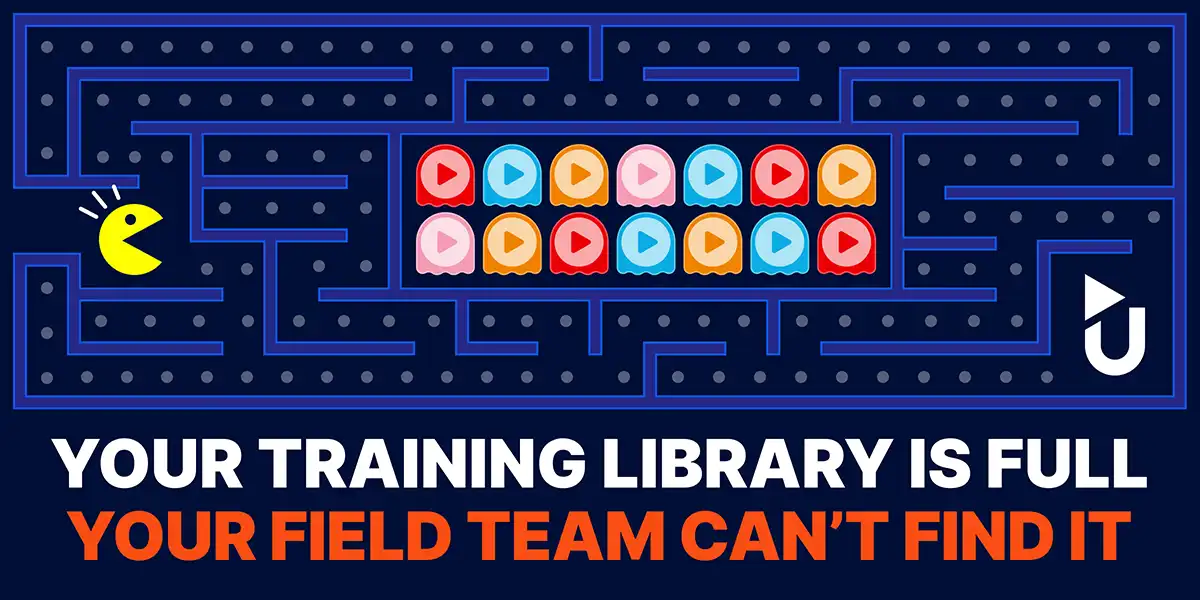
This is what we call ghost training. Content that technically exists but operationally does not, because nobody ever engages with it.
It is one of the most expensive invisible problems in enterprise learning. You are paying for the production. You are paying for the platform. But you are not getting the outcome.
Why the Delivery Model Creates the Gap
The root cause is not laziness or disengagement. It is a structural mismatch between how training is delivered and how employees actually work.
Most LMS platforms were designed for compliance, not consumption. They assume a learner will sit down at a desktop, block off 30 minutes, and work through a module from start to finish. That model made sense when most employees worked from a desk, on a schedule, with dedicated time set aside for development.
That is not how work happens anymore.
Today’s sales reps are in the car between calls. Field technicians are between job sites. Regional managers are bouncing between locations. Frontline workers do not have a desk at all.
The content might be excellent. But if it requires a desktop, a long session, and a specific login, most of the people who need it will never see it. Not because they chose to skip it. Because the delivery model made it functionally inaccessible.
The Hidden Cost Nobody Talks About
When training goes unconsumed, the consequences do not show up as a line item. They show up as slower ramp times, inconsistent messaging, repeated mistakes, and frustrated managers who end up re-explaining things in one-on-ones that should have been handled at scale.
Consider the math. If an enablement team produces a training asset that costs $15,000 in combined time, tools, and review cycles, and only 22 percent of the target audience actually completes it, that is not a content problem. That is a delivery ROI problem.
And it compounds. When field teams learn to expect that training will be hard to find, hard to access, or irrelevant by the time they get to it, they stop looking. Engagement drops not because of one bad experience, but because of a pattern that teaches people to tune out.
The cost is not just wasted production. It is undertrained teams operating in the field without the information they need to perform.
What Changes When You Fix Delivery
The teams that solve this problem do not start by creating more content. They start by changing how content reaches people.
That usually means three things.
First, they move to mobile-first formats. Not mobile-compatible. Mobile-first. Audio and video content that is designed for a phone, designed for motion, and designed for the moments between tasks, not instead of them. Deskless workers in particular respond when the format fits their actual day rather than demanding they change it.
Second, they make content on-demand. Instead of time-blocked training sessions, they create short episodes and segments that can be consumed in five to ten minutes. Content that works during a commute, between meetings, or on a break.
Third, they push content to employees rather than waiting for employees to pull it. Push notifications, curated playlists, and embedded content inside tools employees already use, like a CRM, intranet, or communication platform, ensure the content finds the employee rather than the other way around.
When you combine these three shifts, something predictable happens. Consumption goes up. Not because the content changed, but because the delivery model stopped being a barrier.
Dead Time Becomes Development Time
One of the most underappreciated dynamics in field enablement is the amount of dead time employees already have in their day.
Commutes. Warehouse walks. Downtime between appointments. Travel between sites.
That time is currently unmonetized from a development standpoint. No one is learning during it because the formats do not support it.
When you introduce mobile audio and video into the enablement mix, that dead time transforms. A 20-minute commute becomes a product refresher. A lunch break becomes a competitive positioning update. A walk between meetings becomes a leadership message.
None of this requires new time on the calendar. It reclaims time that already exists.
And because the format is passive and low-friction, adoption tends to build organically. Employees listen because it is easy, not because someone told them to.
How to Know If You Have a Ghost Training Problem
Most organizations do not track the gap between content production and content consumption with any precision. But there are signals.
If your LMS shows completion rates below 40 percent on non-mandatory content, you likely have a delivery problem. If managers are regularly re-explaining topics that were already covered in training, the message is not landing. If your field teams describe training as something that happens “when I get around to it,” the format is not meeting them where they are.
The clearest signal is this: when you ask your enablement team how much content they produced last quarter, they can answer immediately. When you ask how much of it was actually consumed by the intended audience, there is a long pause.
That pause is the ghost training gap. And engagement data is how you start closing it.
Final Thought
The instinct when training is not landing is to make better content. But better content delivered through the same broken infrastructure will produce the same results.
The teams that are solving this problem are not outproducing their peers. They are out-distributing them.
They are meeting employees in motion, in the flow of work, in the moments between tasks. They are using formats that match how people actually consume information today, not how they consumed it a decade ago.
Your training library is probably full of valuable content. The question is whether the people who need it most ever see it.
If they do not, the problem is not what you built. It is how you delivered it.
FAQs:
What is ghost training? Ghost training refers to content that has been created and published but is never meaningfully consumed by the intended audience. It exists in an LMS or content library but has no measurable impact because it never reaches employees in a format or context that supports actual engagement.
How do I know if my organization has a ghost training problem? Look at completion rates on non-mandatory training, especially for field or mobile teams. If rates are consistently below 40 percent, or if managers are regularly re-explaining topics already covered in formal training, delivery is likely the issue, not content quality.
Does switching to audio and video mean replacing our LMS? No. Most organizations that adopt mobile-first media formats keep their LMS for compliance, certifications, and structured learning paths. Audio and video serve as a complementary layer focused on reinforcement, retention, and reaching employees the LMS cannot.
What kinds of content work best for mobile-first delivery? Short-form content in the five to ten minute range performs best. Product updates, competitive intel recaps, leadership messages, customer stories, and quick refreshers on recently launched training are all strong use cases.