



The TLDR;
- Most enterprise media initiatives stall not because IT says no, but because business teams bring IT in too late or without a clear scope
- IT teams are not blocking innovation. They are protecting infrastructure, and that is exactly what you want them to do
- A well-run IT alignment process turns security and governance from objections into accelerators
- The organizations that move fastest are the ones that treat IT as a strategic partner from day one
The Real Reason Media Initiatives Stall at IT
Most internal media projects do not die in a formal review board.
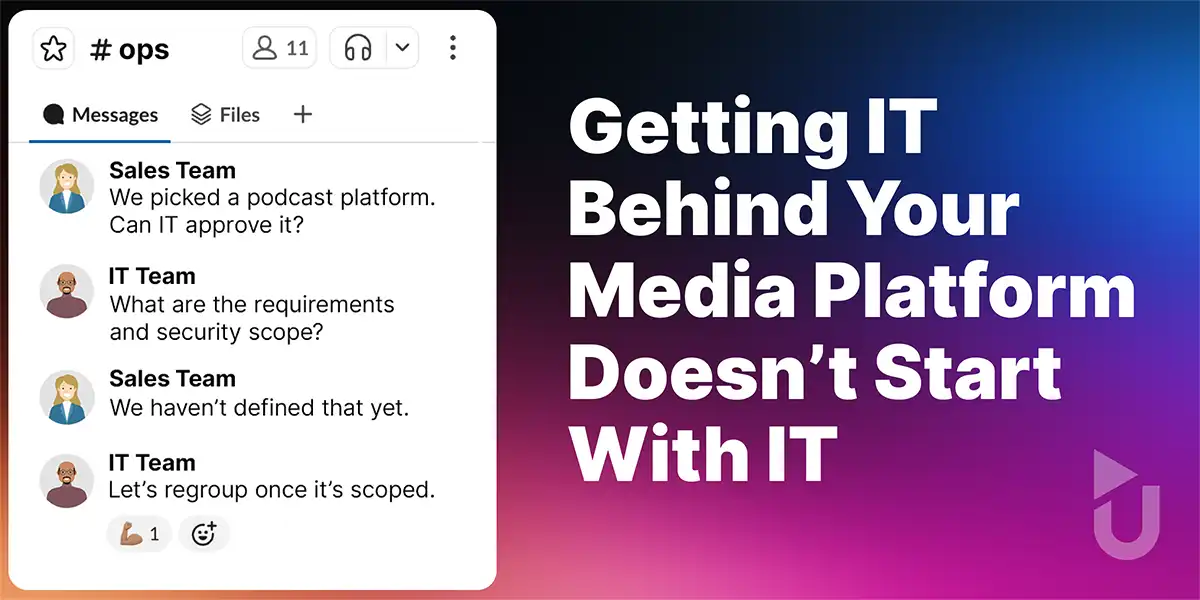
They die in the hallway. In a Slack thread. In a meeting where someone from IT says, “We already have something that does this,” and the conversation loses momentum before it ever really starts.
It is a familiar pattern. A business team identifies a need. Maybe it is sales enablement. Maybe it is training. Maybe it is executive communications. They find a platform that excites them. They build internal support. And then they bring it to IT.
By that point, the project is already framed wrong.
IT is not evaluating whether the idea is good. They are evaluating whether the project has been scoped properly, whether it introduces risk, and whether it duplicates capabilities they already manage.
When the answer to any of those questions is unclear, the default response is not rejection. It is delay.
And delay, in most organizations, is where media initiatives go to quietly disappear.
Why IT Pushback Is Usually a Framing Problem
IT teams push back on new platforms for predictable reasons. And most of those reasons have nothing to do with the platform itself.
They push back because the business case is unclear. When a team says “we want a podcasting tool” without articulating the business problem it solves, IT hears a request for yet another point solution that will need provisioning, monitoring, and eventual sunsetting.
They push back because scope is undefined. Without documented requirements and stakeholder alignment, IT cannot assess impact, integration needs, or resource implications.
They push back because they have seen this before. Enterprise IT teams manage hundreds of tools. They have watched well-intentioned projects launch with enthusiasm and stall within months. Their skepticism is earned.
One of the most common objections sounds like this: “We already have a platform that does that.” Whether it is Microsoft Stream, an existing intranet, or an LMS, IT teams will often point to tools already in the stack. And they are not wrong to ask the question. The burden falls on the business team to clearly demonstrate where those existing tools fall short, not in theory, but in practice.
Until the requesting team can show that the intranet was built to store content, not distribute it, or that the LMS was designed for compliance rather than engagement, the conversation stays stuck.
The fix is not a better pitch deck. It is a better process.
Start With Scope, Not Software
The single most effective thing a business team can do before engaging IT is align internally on the project’s objectives, strategy, and requirements.
This means answering a few straightforward questions before any vendor enters the picture.
What business problem are we solving? Not what tool do we want, but what outcome are we trying to drive. Is it faster onboarding? More consistent field communication? Better visibility into content engagement?
Who is the audience, and how do they work? Are they deskless? Mobile? Distributed across regions? Do they sit in front of a computer all day, or are they on the floor, in the field, or behind the wheel?
What does success look like, and how will we measure it? If you cannot articulate what changes when this initiative works, IT will have a hard time justifying the investment of their time and resources.
When the business team shows up with documented answers to these questions, the IT conversation shifts entirely. It moves from “convince me this matters” to “let me help you make it work.”
This is the difference between projects that take months to clear IT review and projects that move through in weeks.
How to Structure the IT Conversation
Once scope is defined, the next step is a structured introduction between business stakeholders and IT. This is not a sales pitch. It is a technical alignment meeting.
The goal is simple: give IT the information they need to evaluate the project on their terms, while ensuring the business objectives stay front and center.
A strong IT intro meeting covers four things.
First, a brief overview of the platform. Not a product demo. A concise explanation of what the technology does, how it is architected, and where it fits in the existing environment.
Second, a direct conversation about security. For most enterprise IT teams, security is the primary filter. They want to understand authentication protocols, data handling, encryption standards, and compliance posture. They want to know whether the platform has passed formal security reviews before, and how many.
Third, alignment on the organization’s specific InfoSec process. Every enterprise has its own review cadence, its own documentation requirements, and its own approval gates. A good alignment meeting maps these out explicitly so there are no surprises downstream.
Fourth, clear next steps. Who owns what? What documentation is needed? What is the expected timeline? Ambiguity here is where projects lose weeks.
The best platform vendors know this process well. They have been through it hundreds of times and can accelerate it by providing the right documentation proactively, whether that is a security white paper, architecture diagram, or a completed vendor risk assessment.
Security Is Not the Obstacle. It Is the Opportunity.
Many business teams dread the security review. They see it as a gate that slows everything down.
But security is actually where the strongest enterprise media platforms differentiate themselves. A platform that has been built from the ground up for the enterprise, with SSO integration, role-based access controls, IP and domain restrictions, configurable CDN and storage options, and automated user provisioning, does not just survive security reviews. It accelerates them.
The organizations that move fastest through IT approval tend to share a few characteristics.
They choose platforms with a documented track record of passing enterprise security reviews. Not one or two. Hundreds.
They provide IT with comprehensive security documentation upfront, before IT has to ask for it. This includes architecture overviews, encryption standards, compliance certifications, and comparisons against alternative approaches like RSS-based podcast distribution, which lacks the multi-tier security that enterprise content demands.
They address the mobile application question early. In many organizations, the product owner for mobile applications is a distinct stakeholder from the InfoSec team. Making sure both are engaged from the start prevents last-minute objections that can derail timelines.
When security is treated as a strength rather than a hurdle, the IT review process becomes a trust-building exercise instead of an adversarial one.
Why IT Ends Up Seeing the Platform as an Asset
Something interesting happens when IT teams evaluate a well-architected enterprise media platform. The conversation shifts from risk mitigation to value creation.
IT organizations are under constant pressure to consolidate tools, reduce maintenance overhead, and support cross-functional initiatives without adding headcount. A platform that checks those boxes earns a different kind of buy-in.
Low maintenance matters. When a platform requires minimal IT intervention for setup, ongoing management, and content administration, it removes a common objection before it is ever raised.
System consolidation matters. When a single platform can replace or augment multiple disconnected tools that only deliver a fraction of the capability, IT sees an opportunity to simplify the stack rather than expand it.
Flexibility matters. Open APIs for content, search, identity, and analytics. Integrations with BI tools. Configurable infrastructure for CDN and storage. Automated provisioning through existing identity providers. These are not nice-to-haves for IT. They are the criteria that separate tools they tolerate from tools they champion.
When IT moves from gatekeeper to advocate, the entire trajectory of the project changes. Budget conversations get easier. Timelines compress. And the platform becomes part of the organization’s infrastructure strategy rather than a standalone experiment.
The Process That Works
The teams that consistently earn IT buy-in follow a process that looks roughly the same, regardless of industry or company size.
They align on business objectives and requirements before engaging IT. They document scope, audience, success metrics, and stakeholder ownership.
They facilitate a structured IT introduction early in the evaluation, not at the end. They bring the right technical stakeholders into the room and let the platform speak for itself on security, architecture, and integration.
They navigate the InfoSec review with proactive documentation and a clear understanding of the organization’s internal gates. They do not wait for IT to ask for things. They deliver them first.
And they frame procurement as the final step in a process that already has technical and security consensus, not as a negotiation that runs parallel to an unfinished review.
This is not a hack. It is not a shortcut. It is simply the way enterprise technology decisions are supposed to work. And when business teams follow it, building the business case for internal media becomes a matter of execution rather than persuasion.
Final Thought
IT buy-in is not the bottleneck most people think it is.
The bottleneck is misalignment. It is showing up to IT without a defined scope. It is leading with tools instead of outcomes. It is treating security as an afterthought instead of a feature.
The organizations that get internal media platforms approved and deployed quickly are not the ones with the best pitch. They are the ones with the best process.
IT does not want to block your initiative. They want to know it has been thought through. Show them that it has, and you will be surprised how fast the path opens up.
FAQs
Why does IT push back on new media platforms?
IT push back typically stems from unclear business scope, undefined requirements, or the perception that the platform duplicates existing tools. Aligning on objectives and demonstrating gaps in current tools before engaging IT resolves most friction.
What should we prepare before talking to IT about an enterprise media platform?
Document the business problem, target audience, success metrics, and stakeholder ownership. The clearer the scope, the faster IT can evaluate fit, integration, and security requirements.
How long does an IT security review typically take for a media platform?
Timelines vary by organization, but teams that provide comprehensive security documentation upfront and align on the InfoSec process early can often complete reviews in weeks rather than months.
Can an enterprise media platform actually reduce IT workload?
Yes. Platforms designed for the enterprise require minimal IT maintenance, offer automated provisioning, and can consolidate multiple disconnected tools into a single system, which reduces overall tool sprawl and support burden.