



The TLDR;
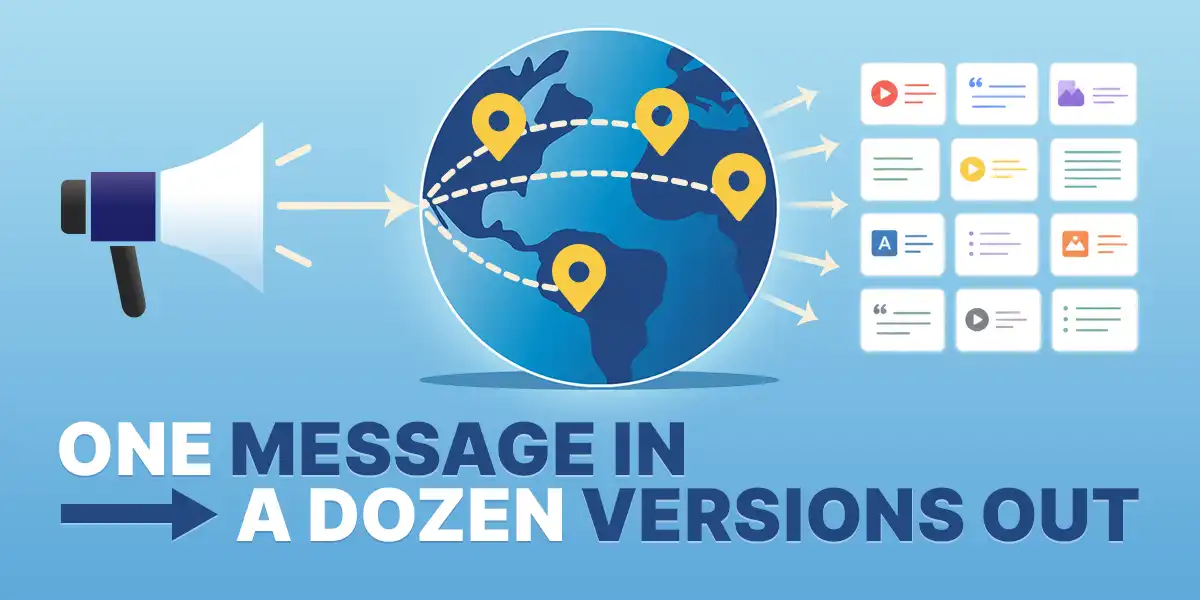
- Global organizations send one message, but by the time it reaches every region, it has fractured into a dozen different versions.
- Time zones, translation delays, and disconnected regional tools quietly create a version-control problem at scale.
- Left unmanaged, that inconsistency turns into compliance risk, brand dilution, and slower speed to market.
- A centralized, mobile-first media platform lets you deliver one consistent message everywhere, without forcing every region through a single bottleneck.
One Message In, A Dozen Versions Out
Picture a product update that leaves headquarters as a single, carefully approved message. By the time it reaches the field in three other regions, it has been forwarded, reformatted, partially translated, summarized in a local meeting, and pinned to an intranet page that half the team never opens.
Nobody did anything wrong. Each regional team was just trying to get the message to their people in a way that worked locally. But the result is the same: one company, speaking with several different voices, often saying slightly different things.
For global operations and communications leaders, this is one of the most frustrating problems to solve, because it does not look like a problem at first. The deck went out. The email sent. The training was assigned. On paper, the message was delivered everywhere. In practice, what each region actually received was a different version of the truth.
Why Global Messaging Drifts
Message drift is rarely the result of one big failure. It is the accumulation of small, reasonable workarounds that pile up across time zones and tools.
Time Zones Turn One Update Into Many
When a message lands at 9 a.m. in one region, it lands at midnight in another. The first region acts on it, adds context, and starts answering questions before the next region has even read it. By the time the message is “live” everywhere, regional leaders have already filled the gaps with their own interpretations. One update has quietly become several.
Translation Adds Lag and Loses Nuance
Translation is necessary, but it introduces both delay and divergence. A message waits in a queue while it is localized, so some regions get it days after others. And nuance gets lost along the way. The careful wording that mattered for compliance or brand tone in the original often softens, shifts, or disappears in the localized version.
Fragmented Tools Create Version Control Chaos
Most global teams are not working from one system. They are stitching together email, regional intranets, an LMS, chat tools, and local file shares. Every handoff is a chance for a new version to spawn. This is the same structural issue we have written about before, where your intranet was built to store content, not distribute it, and where your LMS was built for compliance, not engagement. When the tools are not built to push one consistent message at scale, the message fragments to fit the tools.
The Real Cost of Inconsistency
It is tempting to treat message drift as a cosmetic annoyance. It is not. The costs are real, and they compound.
The first is compliance risk. In regulated industries, the exact wording of a policy update, a safety notice, or a product claim matters. When the version a region acts on differs from the approved original, you are no longer just off-brand. You may be out of compliance. This is part of why secure, consistent delivery has become so important for highly regulated teams, as we covered in secure streaming in financial services.
The second is brand dilution. Every inconsistent message chips away at the sense that the company is one coherent organization. Customers, partners, and even employees start to experience a different company depending on which region they touch.
The third is speed to market. When a message has to be rebuilt and re-approved region by region, the slowest link sets the pace. A launch that should go global in a day instead rolls out over weeks, and the advantage of moving together is lost.
Consistency Is a Distribution Problem, Not a Content Problem
Here is the shift that changes everything. Most teams treat inconsistency as a content problem and try to fix it by writing better source material. But the source message is usually fine. The breakdown happens in distribution.
Solving it means giving every region a single, authoritative source for the message, delivered the same way to everyone. A centralized media platform does exactly that. One approved video or audio update is published once and reaches every region through the same branded app, on mobile or desktop, in the flow of work. This matters most for the people furthest from headquarters, because deskless does not mean disconnected, and those teams are often the ones receiving the most diluted version today.
Centralization does not mean rigidity. Teams can still segment by region, role, or language so each audience gets what is relevant to them. The difference is that segmentation happens on top of one consistent source, not by rebuilding the message from scratch in every market. And because delivery is unified, leaders finally get one view of who actually received and engaged with the message, instead of guessing region by region.
What Consistency Without Bottlenecks Looks Like
The fear with centralization is always the same: that it creates a single chokepoint and slows everyone down. Done right, it does the opposite.
Consider how Astellas, a Tokyo-based pharmaceutical company with U.S. operations, scaled private podcasting for learning and engagement. An inherently multi-region organization, Astellas used a single secure platform to reach distributed field teams in the moments they were actually available, like windshield time between appointments. The same model that delivers consistent training also delivers consistent messaging, because the infrastructure is the same.
The practical playbook for global teams looks like this. Publish the authoritative version once. Let regions localize and segment on top of that single source rather than around it. Deliver everything through one mobile-first experience so the message reaches people wherever they work. And use named-user analytics to confirm the message actually landed, in every region, not just that it was sent.
Same company. Same message. Finally the same, everywhere.
FAQ
Why do global companies end up with inconsistent internal messages? Usually not because of bad content. It is because the message passes through different tools, time zones, and translation steps in each region, and each handoff introduces a new version. The drift is structural, not intentional.
Isn’t translation the main cause of inconsistency? Translation adds delay and can lose nuance, but it is only one factor. Fragmented distribution tools and time-zone gaps often do more damage, because they let multiple competing versions of a message circulate at once.
How does a centralized media platform keep messaging consistent without slowing teams down? It gives every region one authoritative source, published once and delivered the same way everywhere. Regions still segment and localize on top of that source, so consistency and local relevance coexist instead of competing.
Can we still tailor messages by region or language? Yes. Centralization governs the source of truth, not the audience experience. You can segment by region, role, product line, or language while keeping everyone anchored to the same approved message.