


The TLDR;
- Offboarding usually shuts down email, badge, and SSO to core systems. The internal media employees actually downloaded, cached, and saved to personal devices often keeps working long after their last day.
- People do not consume content where it lives. They save it, forward it, and sideload it to watch or listen on their own time, which means “shared” content quietly becomes “distributed” content no one can recall.
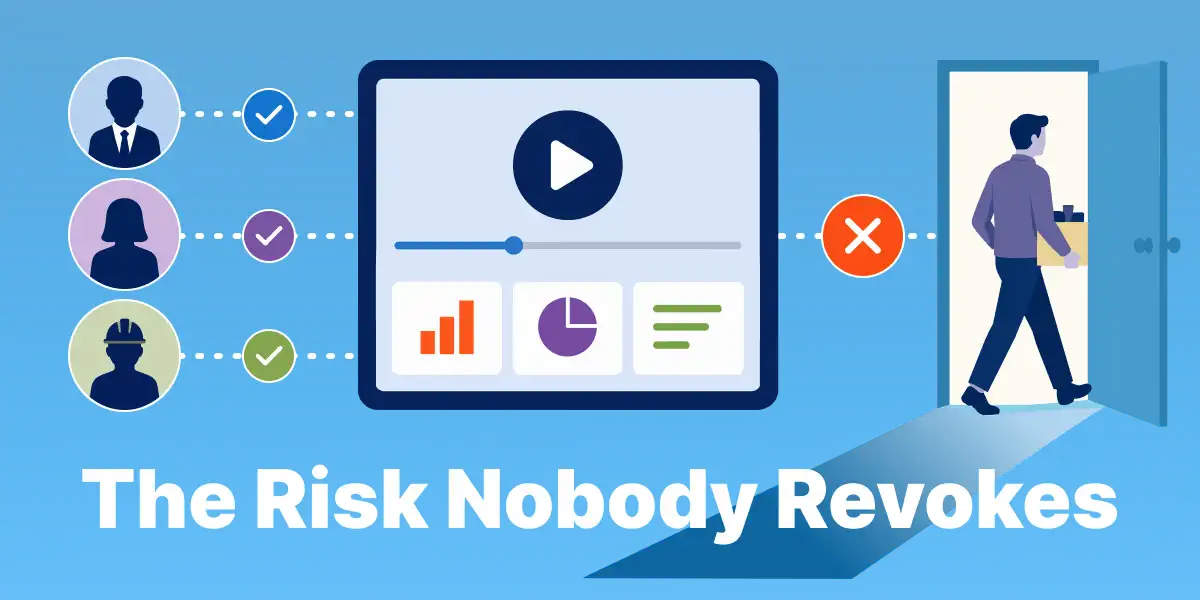
- Named-user access, role-based permissions, and instant revocation keep sensitive pricing, strategy, and training media under enterprise control, even after someone walks out the door.
- Treating internal content as a governed asset, not just something you share, protects your IP, your competitive intel, and your compliance posture without slowing down the people who need access.
The Exit Interview Covers the Laptop. It Misses the Content.
Most offboarding checklists are good at the obvious. Collect the badge. Disable the email account. Revoke SSO to the CRM, the HR system, and the finance tools. Wipe the company laptop if there is one. By the end of the day, the departing employee looks fully locked out.
Then there is everything they consumed along the way. The product roadmap briefing they downloaded for a flight. The pricing strategy session they saved to a personal phone. The competitive teardown they forwarded to themselves so they could finish listening over the weekend. None of that shows up on the checklist, because none of it lives in the systems the checklist was built around.
This is the blind spot. Companies have gotten disciplined about revoking access to applications. They have not gotten disciplined about revoking access to content. And in most organizations, the content is where the sensitive material actually lives.
What Actually Walks Out the Door
It helps to be specific about what we are talking about. Internal media is not just town hall recordings and culture videos. For a lot of teams, it is some of the most sensitive material the company produces.
Think about the categories. Pricing and discounting guidance. Product roadmaps and launch timing. Competitive intelligence and win-loss breakdowns. The rationale behind a reorg or an acquisition, shared with leadership. And the proprietary sales enablement content that took months to build, from playbooks to objection handling to deal strategy.
This is the material that gives a company its edge. It is also exactly the material a departing employee is most likely to have saved, because it is the material that was most useful to their job. When that person lands at a competitor, the content does not stay behind out of courtesy. If you cannot revoke access to it, you are relying on goodwill.
How “Shared” Quietly Becomes “Distributed”
The reason this happens is not negligence. It is behavior. People do not consume content where it sits. They pull it onto whatever device and whatever moment fits their day.
Most of the tools companies use to deliver internal content were built to store files, not to govern access to them. A link to a shared drive or an intranet page gets the file in front of someone, but once it is downloaded, the original system loses sight of it. There is no record of who still has a copy. There is no way to pull it back.
So the lifecycle looks like this. Content gets posted. Employees download it to read or listen offline. Copies land on personal phones, personal laptops, and personal cloud accounts. Links get forwarded. Over months and years, a single sensitive file can scatter across dozens of unmanaged devices. By the time someone leaves, “we shared that internally” has quietly become “that is sitting in places we cannot see.”
The Real Exposure Is IP, Competitive Intel, and Compliance
The risk here is not abstract, and it is not only about disgruntled employees. Most of the exposure is ordinary. Good people leave on good terms and still have your strategy deck in their downloads folder.
Three kinds of exposure stack up. The first is intellectual property and competitive intel, where pricing, roadmaps, and strategy in a competitor’s hands erode the advantage you spent real money building. The second is compliance. In regulated industries like financial services, pharma, and healthcare, you are expected to prove who could access sensitive material and to show that access ended when employment did. Teams running secure streaming in financial services already treat access control as table stakes, because an auditor will eventually ask. The third is plain liability. When you cannot say where content went or who still has it, you cannot answer the questions that surface after a breach, a lawsuit, or a competitive surprise.
The common thread is visibility. You cannot govern what you cannot see, and you cannot revoke what was never under control to begin with.
Govern Content Like the Asset It Is
The fix is not to lock content down so hard that nobody uses it. That just pushes people back to email and workarounds. The fix is to deliver content through a system that treats access as something you grant and revoke, not something you lose track of after the download.
That starts with named-user access. Every person who can reach a piece of content is a known identity, not an anonymous link holder. Role-based permissions make sure people see only what their role requires, so the pricing strategy series is not sitting in front of the entire company by default. Streaming rather than downloading keeps content inside an environment you control, instead of scattering copies across personal devices. And secure user management tied to your identity provider means that when HR offboards someone, access ends automatically and instantly, not whenever someone remembers to clean up a folder.
Just as important, you get named-user analytics. You know what was accessed, by whom, and when. That is the visibility that turns “we think that is fine” into “we can show exactly who had access and confirm it ended.” Getting there is less about buying more security tools and more about how you deliver content in the first place, which is why bringing IT and security into the conversation early tends to make these programs stronger, not slower.
FAQs:
What happens to internal content when an employee leaves? In most companies, application access is revoked but content access is not. Anything the employee downloaded, cached, or forwarded can remain accessible on personal devices after their last day, because storage-based tools have no way to pull copies back.
Isn’t revoking SSO and email enough? Not on its own. SSO and email cover the systems of record, but they do not reach files that have already been downloaded to personal devices or saved outside managed systems. You need delivery that keeps content inside an environment you control and access tied to identity, so revocation actually removes reach.
Which teams should own internal content governance? It is shared. IT and security own identity, access, and audit. Communications, enablement, and training own the content itself. The strongest programs treat governance as a joint responsibility rather than leaving it to whoever happened to upload the file.
How is this different from storing content in our intranet or shared drive? Storage tools are built to hold files and hand out copies. They are not built to track who still has access or to revoke it when someone leaves. Governing content means delivering it through a system where access is named, permissioned, and revocable, not just posted and forgotten.