

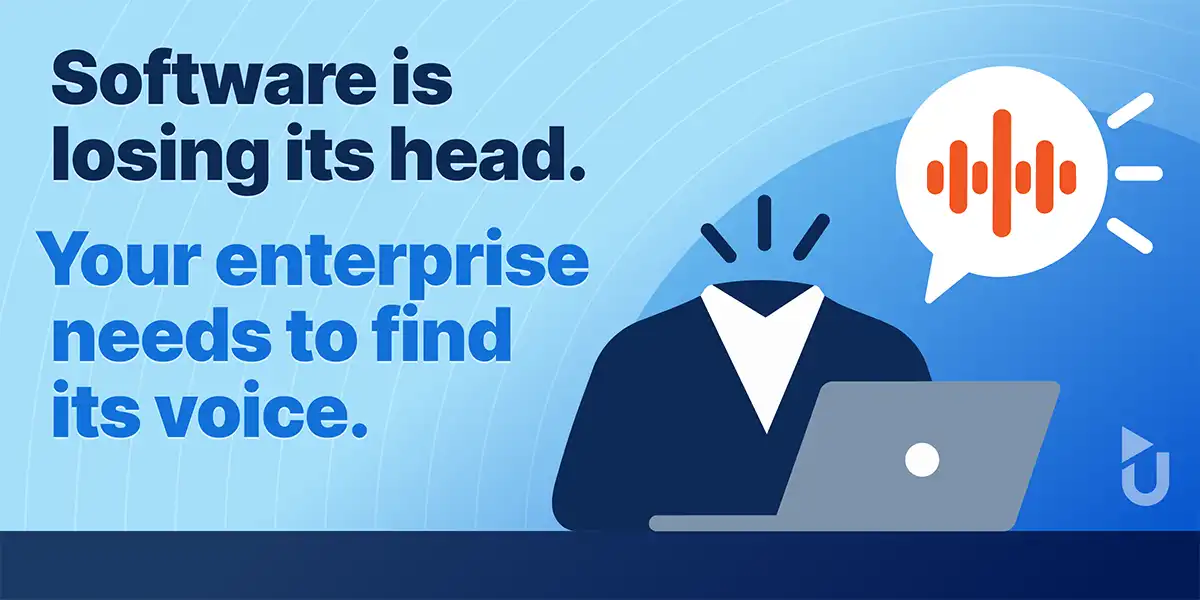
Andreessen Horowitz recently published “Is Software Losing Its Head?” — an argument that the graphical interface, the “head” that made enterprise software sticky for two decades, is being quietly decapitated by AI. It’s one of the sharpest pieces I’ve read on where enterprise software is going. I want to build on it, because I think it points to something most companies haven’t priced in yet: as software loses its head, your enterprise has to find its voice.
The argument, briefly
a16z’s claim is that the user interface used to be the moat. Software was defensible because humans lived in the interface — they learned the screens, built muscle memory, kept the data clean because the workflow forced them to. The system of record won because people had nowhere else to go.
In the agentic era, that advantage weakens. When an AI agent can read and write directly to the database through an API or the Model Context Protocol, the interface becomes optional. As a16z puts it, “In the SaaS era, the system of record was defensible because humans lived in the interface. In the agentic era, that advantage weakens.” The screen — the head — is no longer where the value lives.
So where does defensibility go? a16z argues it moves to a handful of durable things: proprietary data that’s hard to recreate, ownership of the “action layer” where work actually gets executed, and the ability to reach into the real world. Storing records isn’t a moat anymore. Doing something with them is.
I think that’s right. And I think it has a consequence the article doesn’t fully draw out.
The head doesn’t disappear — it changes shape
If agents are going to click the buttons, read the dashboards, and reconcile the records, what’s left for the humans?
The part that was always the point: understanding. A person doesn’t want to log into four systems and assemble a picture of what happened this quarter. They want to be told — clearly, in a way that respects their time and actually lands. The interface humans need in an agentic world isn’t a screen full of controls. It’s a briefing. A story. A voice.
And here the generational data matters. The workforce we’re now hiring grew up with YouTube, TikTok, Spotify, and podcasts as their default information diet. They are fluent in media and impatient with dense text. Ask them to absorb a ten-page PDF and you’ll lose most of them; give them a six-minute audio brief or a two-minute video and you’ll reach nearly all of them. This isn’t a knock on anyone — it’s just where attention has moved.
Put those two forces together and you get the real shift. As software sheds its GUI, the human-facing layer of the enterprise stops being screens and becomes media. The head that survives is a media head.
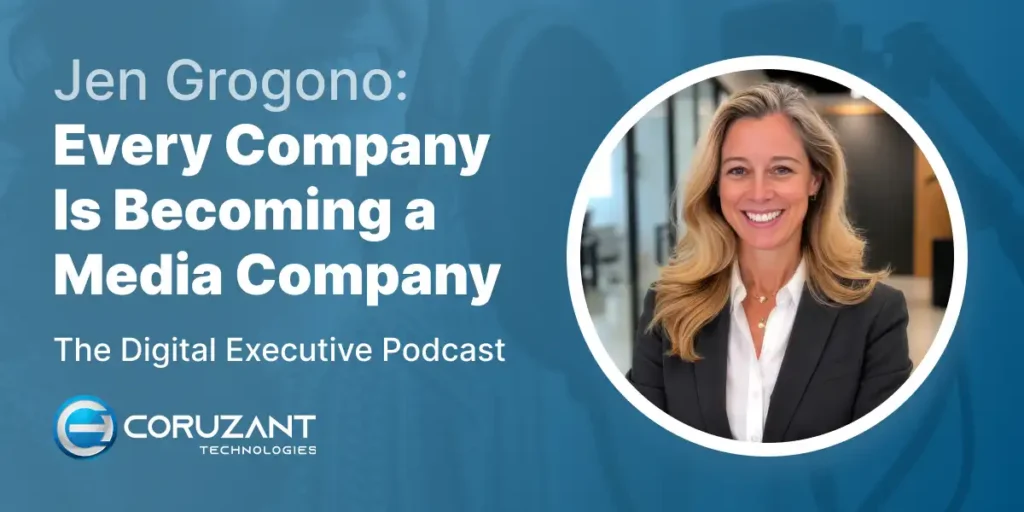
That’s why our CEO, Jen Grogono, keeps saying that every enterprise now has to operate like a media company. Not as a metaphor — as an operating model:
- Better engagement drives real business outcomes. Employees who actually consume and retain what you communicate are more productive and more likely to stay. Communication you can’t measure is a cost; communication you can measure and improve is a lever.
- The audience has changed. Younger generations don’t want to read the memo. They want to hear it and watch it. Formats that were “nice to have” are now table stakes.
- Media can’t be an afterthought. Every meaningful internal and external message — the blog post, the policy update, the all-hands, the product page — needs a media version shipped alongside it, not bolted on months later.
Notice what that requires. To operate like a media company, an enterprise needs to create content continuously, publish it to the right people, know whether it landed, and do all of it at the speed and volume of modern communication. No human team can hand-craft that. This is exactly the work AI is now good at — and exactly the work that needs a platform underneath it.
This is the a16z thesis, applied to communication
Here’s the part I find genuinely exciting, and the reason I’m writing this instead of just forwarding the article.
The moats a16z says will matter in the agentic era — proprietary data, ownership of the action layer, real-world execution — are precisely the moats an enterprise builds when it operates like a media company on a platform like uStudio:
- Your library of media and, more importantly, your engagement data — who watched, who finished, who acted — is proprietary and impossible to recreate. That’s the data moat.
- Publishing to your workforce and customers is the action layer. It’s not storing a record of a message; it’s the message actually reaching a person and changing what they know.
- Reaching every employee, partner, and customer, on their device, in a format they’ll actually consume, is real-world execution.
uStudio has been API-first from the start. We didn’t build a media platform that happens to have an API; we built an API that happens to have a front end. That decision looked ordinary a few years ago. In a world where the interface is losing its primacy and agents are the new operators, it turns out to be the whole game. Everything below can be driven by code — and therefore by AI.
What our customers can build with AI + the uStudio APIs
We’ve proven this ourselves. uStudio Labs is a set of applications we built entirely on top of the same public APIs our customers use. Each one maps to a capability an enterprise-as-media-company needs:
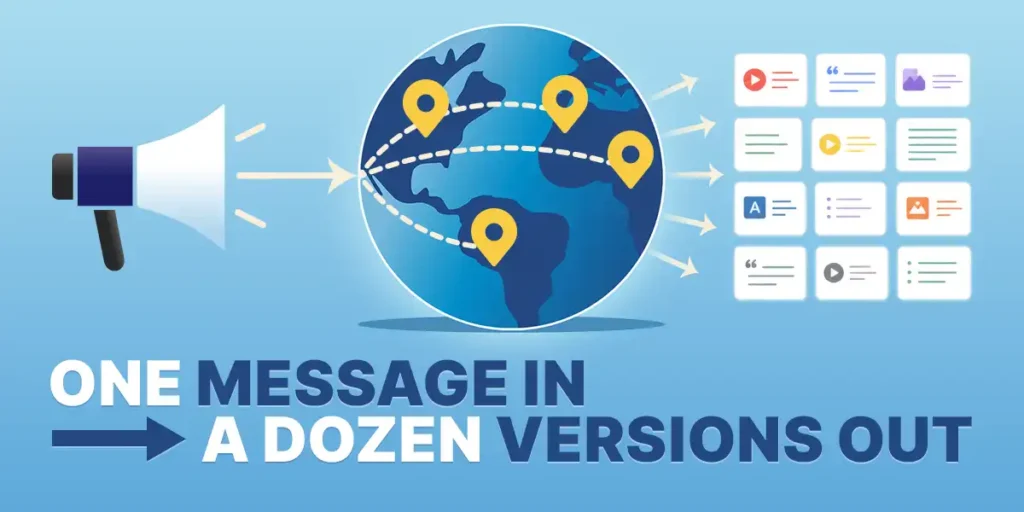
Create. The heaviest lift in media is production — and it’s the part AI has changed most. Written content can be turned into narrated audio and video automatically; transcripts, captions, chapter markers, titles, and descriptions can be generated rather than typed. One of our Labs projects, Autocast, takes existing written material and produces a media version of it automatically — the literal embodiment of “every blog post ships with an audio version.” The uStudio Videos API handles upload, metadata, and transcript generation as programmable steps, so “make a media version of this” becomes an API call an agent can make, not a project you schedule.
Publish. Creating content is worthless if it doesn’t reach the right audience. The Destinations and Collections APIs let you route and package content programmatically, and our Labs Recommendations work personalizes what each viewer sees — the difference between broadcasting and actually landing. An AI agent can decide who should see what and publish it, without a human staging every release.
Discover. As your media library grows, findability becomes the bottleneck. Our Content Finder project uses AI to search inside your media — not just titles and tags, but what’s actually said — and returns deep links to the exact moment. Ask a question, get taken to the ten seconds of video that answer it. That’s how a library of thousands of assets stays usable.
Measure. This is the moat. The Statistics API and our analytics pipeline turn engagement into data you can act on: completion rates, drop-off, which segments engage with which content. Media companies live and die by these numbers; now every enterprise can, too. And because it’s data, AI can close the loop — flagging what’s not landing and suggesting what to make next.
Operate headlessly. Finally, the a16z future itself: our MCP work exposes the uStudio platform to AI agents directly. An agent can create, publish, and analyze media through uStudio without ever touching a screen. That’s software with its head removed — and it works because the platform was API-first the whole time.
The takeaway
a16z is right that software is losing its head. But for enterprises, the lesson isn’t defensive — it’s directional. The screen-based interface is fading; the media-based interface is rising to replace it. The companies that win the next decade will be the ones that communicate like media companies: creating continuously, publishing precisely, and measuring relentlessly — with AI doing the heavy lifting and an API-first platform underneath.
Software may be losing its head. The enterprises that find their voice will be the ones still worth listening to.
Interested in building media-driven products on the uStudio APIs? Reach out – it’s the same platform we built uStudio Labs on.