



The TLDR;
- Most teams blame low engagement on content quality. The real culprit is usually a fragmented stack of tools that were never built to work together.
- Employees will not hunt across an LMS, an intranet, email, and a couple of video tools to find what they need. When content is scattered, it gets ignored.
- A unified media platform delivers audio and video in one place, mobile-first and in the flow of work, without adding another tool to the pile.
- The payoff is a consistent experience, measurement you can trust, and engagement that climbs because friction drops.
The Content Isn’t the Problem. The Delivery Is.
You have probably read that your LMS was built for compliance, not engagement. You have probably read that your intranet was built to store content, not distribute it. You may have even read that your sales enablement isn’t broken, it’s just built for the wrong decade.
Each of those is true. But notice the pattern.
Every one of those arguments puts a single tool on trial.
The bigger story is what happens when you put all of them in the same room.
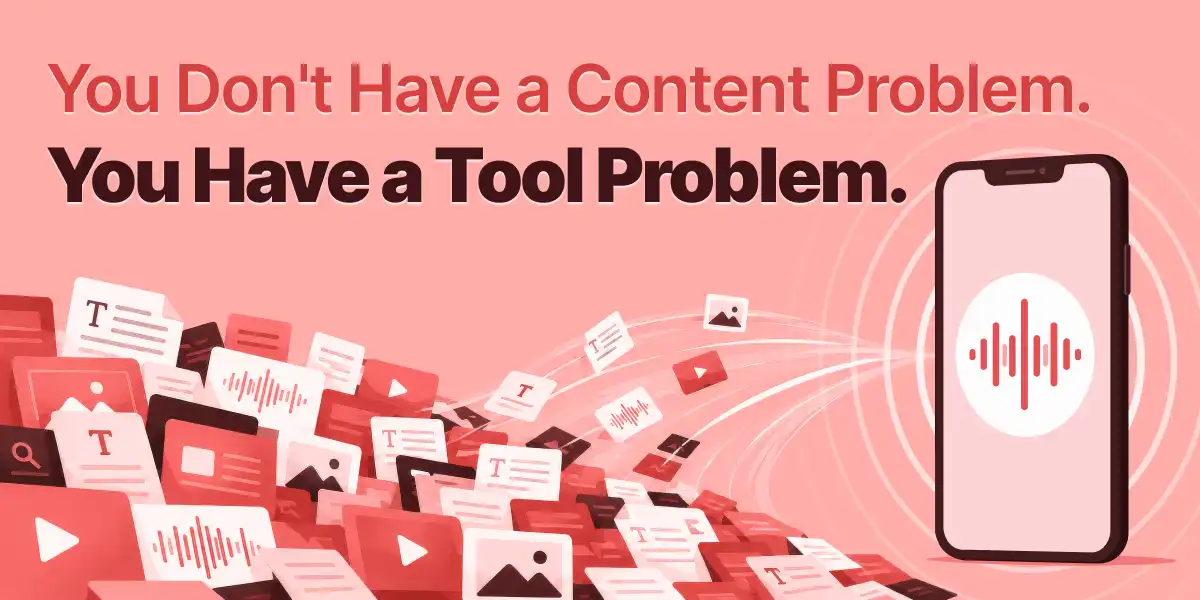
Your team produces a strong product update. It lands in the LMS. The companion one-pager lives on the intranet. The launch video sits in a separate video tool. The reminder goes out by email. The talk track ends up in a chat thread.
The content was good. The experience was a scavenger hunt.
That is the tool problem. And no amount of better content fixes it.
What Tool Sprawl Actually Costs You
Tool sprawl rarely shows up as a line item. It shows up as friction.
Gaps. A message reaches the people who happen to check one system and misses everyone who does not.
Duplication. The same update gets reformatted four times for four platforms, and the versions slowly drift out of sync.
Dead ends. An employee taps a link on their phone, hits a desktop-only login, and gives up.
Each handoff between tools is a place where attention leaks out. A rep on the road, a technician in the field, a manager between meetings. None of them have the patience to chase content across systems, and none of them should have to.
Multiply that across every update, every team, and every week, and you get the quiet erosion most leaders mislabel as a content problem. The work was done. It just never landed.
Three Hidden Failures of a Fragmented Stack
An Inconsistent Experience
When content lives in five places, employees get five different experiences. Different logins. Different search. Different playback. Some mobile-friendly, some not. People stop trusting that the thing they need will be where they expect it, so they stop looking. Once that trust is gone, even your best content inherits the reputation of your worst tool.
Measurement Blind Spots
A fragmented stack fragments your data too. The LMS knows about completions. The video tool knows about plays. Email knows about opens. None of them talk to each other, so nobody can answer the only question that matters: did the message reach the people who needed it, and did it stick? When you can see how your content actually gets discovered and consumed in one place, those blind spots start to close.
Engagement That Quietly Erodes
Engagement does not usually collapse. It leaks. Every extra step, every wrong-format file, every dead link shaves a little off. Because the failures are spread across tools, no single dashboard ever shows the full picture. So teams respond by making more content, which adds more to find, which makes the sprawl worse. It is a treadmill, and the content team is the one running on it.
What Consolidation Looks Like (and What It Doesn’t)
Consolidation does not mean ripping out your systems of record. Your LMS still certifies. Your CRM still tracks deals. Your intranet still houses policy.
Consolidation means unifying the layer employees actually touch: the place they go to watch, listen, and stay current.
A unified media platform gives audio and video a single, branded home that works on mobile and desktop, plays offline, and pushes updates instead of waiting to be found. It can embed into the intranet, the LMS, and the tools people already use, so the experience feels like one place even when the back end is still many.
This is the path Astellas took when it scaled private podcasting for learning and engagement across a global, distributed workforce. The content was not new. The delivery was. Putting it in one mobile-first experience is what turned scattered material into something employees actually consumed.
You are not adding a sixth tool. You are giving the other five a front door.
Consolidation Is an Engagement Strategy, Not Just a Cost Play
Consolidation usually gets pitched to IT as a way to cut redundant licenses. That is real, and it matters. But the bigger return is engagement.
When delivery is unified, the experience is consistent, so people trust it. Content is mobile-first, so deskless and on-the-go employees can reach it. Updates push, so the message finds the person instead of the other way around. And measurement lives in one place, so you can finally prove what is working and put more behind it.
For enablement, comms, and IT leaders, that reframes the whole conversation. The question is no longer how to make better content. It is how to stop losing good content in the gaps between your tools.
Answer that, and engagement takes care of itself.
FAQs:
Does consolidating mean replacing our LMS or intranet?
No. Systems of record stay. Consolidation unifies the delivery and engagement layer, the place employees go to consume content, and embeds into the tools you already use.
How is this different from just adding another tool?
A unified media platform reduces the number of places employees have to check rather than adding one more. It acts as the front door to content that may still live in several systems.
How do we know employees are actually engaging?
With a single delivery layer, you get named-user analytics in one place: who listened or watched, when, and where they dropped off, instead of stitching together reports from separate tools.
Is a unified platform secure enough for internal content?
Yes. Enterprise-grade delivery includes SSO, role-based access, and audit-ready reporting, so consolidation does not mean loosening control.