


The TLDR;
- Pharma companies face unique challenges with compliance, distributed teams, and content overload
- Streaming media is helping teams reach employees more effectively across internal comms, learning, DEI, and enablement
- Mobile-first access, secure embeds, segmentation, and analytics are key to scale
- This playbook captures real lessons from pharma leaders using enterprise media to boost reach, retention, and results
The pharmaceutical industry is no stranger to complexity. From compliance requirements to global workforces and field-based teams, internal communication and learning programs face unique challenges. Yet across dozens of real-world implementations, one trend has emerged: secure enterprise media is changing the way pharma works.
This playbook brings together lessons learned from some of the most innovative pharmaceutical companies using streaming media to improve communication, training, and employee engagement. Whether you are starting your journey or looking to scale an existing program, these insights can help you move faster with more confidence.
A Cross-Functional Strategy
Unlike many initiatives that stay siloed within a single department, enterprise media adoption in pharma tends to cut across internal comms, learning and development, sales enablement, field ops, HR, and IT. Why? Because secure streaming solves problems that show up in multiple functions.
In one case, a mid-sized global pharma company used uStudio to launch a secure podcast network that spanned training, culture, executive updates, and product announcements. Each department had its own audience and content style, but the underlying infrastructure remained unified.
The result was not just cost savings and operational efficiency, but also a better employee experience. Listeners only had to learn one app. Leaders only had to pull one set of analytics. And IT only had to manage one integration.
Lesson 1: Launch with Learning & Development and Expand Quickly
Many pharma programs start with learning and development. Podcasts and video streaming offer an ideal format for reaching busy, distributed learners with short, high-impact content.
Just-in-time learning becomes possible when employees can listen while driving to appointments or during other downtime. According to Astellas Pharma, a Tokyo-based pharmaceutical company with U.S. headquarters in Northbrook, Illinois, this was a game changer for their field reps. “We saw engagement go up dramatically once we moved to a format they could access during windshield time.”
But the real lesson is what happens next. Once learning and development shows success, other departments take notice. A DEI leader wants to launch a monthly conversation series. An executive wants to address the company more directly. HR wants to reduce inbox clutter and increase compliance rates. Media creates momentum.
Lesson 2: Segment Audiences by Role and Region
Pharma organizations are among the most complex when it comes to org charts. That complexity often makes traditional communication channels feel blunt or noisy. With secure media, teams can segment content by job role, location, product line, or language, and deliver messages that feel tailored.
One company used this to support a massive transformation initiative that involved different messaging tracks for R and D, marketing, and the field. Each group received regular updates from leadership, tailored to what they needed to know most. And because it was all delivered in the same app, engagement stayed high.
Lesson 3: Keep it Mobile First
In pharma, not everyone sits at a desk. From lab techs to field reps to warehouse staff, many employees are on their feet or on the move. That is why the most successful programs treat mobile not as an afterthought but as the primary interface.
Push notifications become critical for driving awareness. Offline listening makes content accessible in low-connectivity environments. And mobile-first design ensures that even long-form content feels approachable.
“We made a decision early on to treat mobile as the default,” said one comms leader. “It forced us to simplify our message, think more visually, and focus on real-time value.”
Lesson 4: Blend Top Down and Bottom Up
The most effective programs do not just push content from the top. They also invite feedback and contribution from the bottom. One pharma company ran a quarterly contest where employees submitted podcast episode ideas or questions for leaders to answer on-air. Another created a rotating series where managers hosted short updates from their regions.
Novo Nordisk, for example, built a full internal podcast network with shows like Fueling the Novo Way and Courageous Conversations. These programs highlight diverse voices, build cultural alignment, and give employees at every level a sense of connection to the bigger picture.
This not only increased engagement, it also made the program more sustainable. Leaders did not have to carry the content burden alone. And the audience started seeing the platform as a two-way communication tool, not just another place to be talked at.
Lesson 5: Make Data Your Compass
Pharma is a data-driven industry. And internal media should be no exception. From measuring compliance to understanding what messages are resonating, engagement analytics help teams continuously improve.
Named user tracking allows teams to see who is engaging, how often, and where they drop off. That makes it possible to target follow-up, refine messaging, and demonstrate impact.
Several customers reported using engagement data to validate and protect their internal budgets. “We were able to show that our new media program had a higher completion rate than our old LMS courses, with less time spent. That opened up more funding to grow the program.”
Lesson 6: Embed Content Inside the Flow of Work
The latest advancement in enterprise streaming is the ability to embed secure media directly into intranets, SharePoint pages, or LMS tools. This has been a breakthrough for pharma teams looking to meet employees where they are.
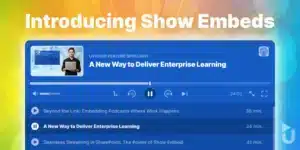
Instead of asking users to visit another app or remember a separate login, embedded media appears right alongside other daily resources. And because uStudio’s Show Embeds are authenticated, all engagement still counts in the analytics.
This has been especially useful for:
- Compliance training inside LMSs
- Culture content on intranet homepages
- Product updates in sales enablement tools
- DEI programming inside community portals
Key Takeaways
- Pharma companies are using secure streaming to reach distributed teams with higher engagement
- Programs often start with learning and development but quickly expand to include comms, HR, DEI, and leadership
- Mobile-first design is essential for reaching non-desk employees
- Segmentation improves relevance and compliance
- Embeds bring content into the flow of daily work without sacrificing security or analytics
- Feedback loops and named user data allow for continuous optimization and budget justification
Final Word
The pharmaceutical industry is undergoing rapid change. From digital transformation to workforce expectations, the pressure to communicate better and train faster is not going away.
Streaming media offers a modern, secure, and scalable way to do both. And the companies that embrace it are finding new ways to connect, engage, and grow, not just with their customers, but with their own people.
Want to learn how pharma leaders are using secure media to transform internal communication and training?
Talk to our team or request a demo today.
FAQs:
What makes pharma different when it comes to internal media?
Pharma companies tend to be highly regulated, geographically distributed, and team-dense. Secure enterprise media supports personalization, compliance, and real-time reach across all of these variables.
Is this just for training?
Not at all. Many pharma programs start with learning and development, but most grow to include comms, HR, DEI, product, and leadership messaging as well.
What are the security requirements?
uStudio integrates with enterprise identity providers using SAML and SCIM, supports encrypted media delivery, and ensures playback data is tied to verified users.
Can we use this with our intranet or LMS?
Yes. uStudio’s Show Embeds allow secure podcast and video content to be placed directly inside platforms like SharePoint or your LMS while preserving analytics and access control.
What are the most common use cases?
Executive updates, DEI conversations, product launches, field sales training, compliance refreshers, and culture-building series are all popular across pharma companies using uStudio.