


TL;DR
- Gallup’s 2026 workplace report found that only 20 percent of employees are engaged, with disengagement costing organizations nearly $10 trillion annually.
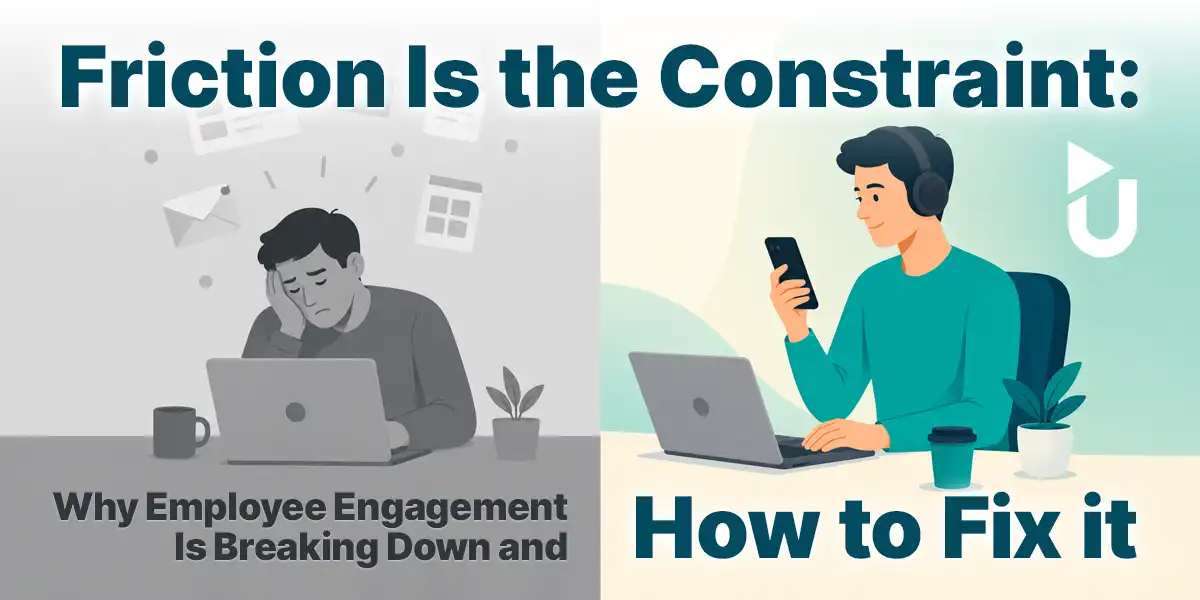
- The issue is not a lack of communication or training content. The issue is friction. Employees are expected to engage with systems and formats that feel slow, static, and disconnected from how they consume information today.
- Traditional enterprise delivery models like portals, long-form content, meetings, and email create barriers to engagement instead of enabling it.
- Organizations that shift to mobile-first, on-demand media experiences see stronger engagement, higher repeat consumption, and better execution because the content fits naturally into the flow of work.
- The companies outperforming today are not simply creating more content. They are building internal media systems that reduce friction and make engagement easy.
Gallup’s newly released State of the Global Workplace 2026 report paints a sobering picture:
- Only ~20% of employees are engaged,
- Disengagement is costing nearly $10 trillion in lost productivity,
- And engagement is declining, not improving.
The cost is a staggering $10 trillion in lost productivity tied directly to disengagement.
Companies are investing billions into AI, digital transformation, and new tools, yet they are struggling to translate those investments into results.
For leaders, this is a wake-up call.
Outside of work, the expectation has already shifted. As Puck recently noted of modern media consumers, “consumers come to [content] expecting an audio or video experience.”
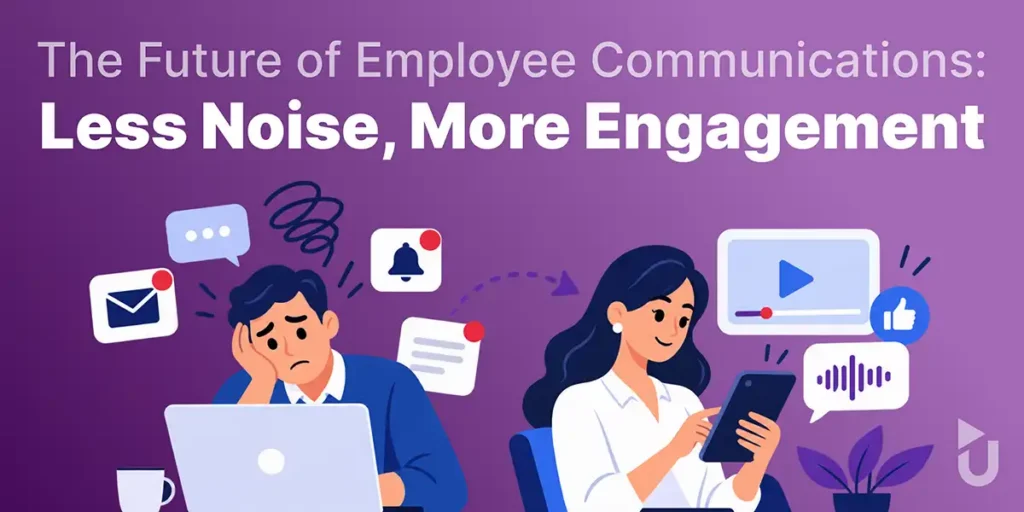
Employees bring that same expectation into the workplace, but most enterprise systems still deliver information in formats that feel slow, static, and effortful.
The Real Engagement Problem: Friction
Most organizations deliver critical information through systems that feel like….well, work:
- Portals
- Meetings
- Long-form content
Employees simply don’t engage with these systems. They skim, skip, or ignore them.
Not because they don’t care. Because engagement requires effort.
And when engagement requires lots of effort, it doesn’t happen.
What Happens When You Remove Friction
Everything changes when information is delivered through a frictionless, familiar experience.
Here at uStudio, our software functions like the platforms employees already use every day:
- On-demand
- Mobile-first
- Simple and intuitive
There is zero burden on the end user, the employee. No searching. No training. No disruption.
And that’s when engagement turns.
People don’t just receive information. They absorb it. They pay attention. They come back.
From Engagement to Execution
When engagement turns, execution follows.
Core messages cascade naturally, reaching employees in moments where they can actually listen and act.
This is the difference between communication that gets delivered – and communication that actually drives performance.
What Engaged Employees Actually Do
And when organizations can get this right, behavior changes. Our customers see this every day.
For example, at CCC Intelligent Solutions, new hires don’t just complete onboarding: they return to content repeatedly, using podcasts powered by uStudio as an on-demand learning library to prepare for real-world interactions.
Or at another one of our customers, Astellas, their focus is on meeting employees in the flow of work, accessing content in the moment of need. And critically, they’ve built a feedback loop:
“That feedback then drives the next episode… this becomes an endless loop.”
Finally, at Southern Glazer’s, the shift to authentic, accessible audio content, powered by uStudio, has led to measurable outcomes:
- 70x more consumption than one-off videos
- $1.1M annual productivity gain from employee found time.
Their takeaway?
“Imperfection equals connection.”
What Engaged Employees Tell Us
Across all of these programs, the feedback is remarkably consistent:
- “I actually use this.”
- “I can find what I need instantly.”
- “It fits into my day.”
And maybe most importantly:
- “It feels like it was made for me.”
That’s the difference between content that exists… and content that connects.
How uStudio Turns Engagement into a System
These outcomes aren’t accidental; they’re enabled by a fundamentally different approach to enterprise content.
Targeted Content Delivery
Employees see content tailored to their role, team, or region – cutting through noise and increasing relevance.
On-Demand, Mobile-First Access
Whether in the field, between meetings, or preparing for a customer conversation, content is available instantly.
Continuous Measurement
With our software, leaders don’t guess what’s working they know. Our full suite of analytics shares what’s being consumed, when it’s being consumed, and what’s driving repeat engagement.
Feedback-Driven Content Loops
High-performing organizations don’t just publish – they adapt. They build systems where: engagement data → shapes content → which drives more engagement
The Bottom Line
The old model was simple:
Create more content. Push it out. Hope it sticks.
But today, that approach is breaking down. Because in a world where only 1 in 5 employees is engaged, success depends on precision:
- Deliver less, but make it matter
- Replace noise with relevance
- Create content employees pull, not content they’re forced to consume
Engagement is powered by a strong internal media system.
And the companies building that system today are the ones that will outperform tomorrow.